
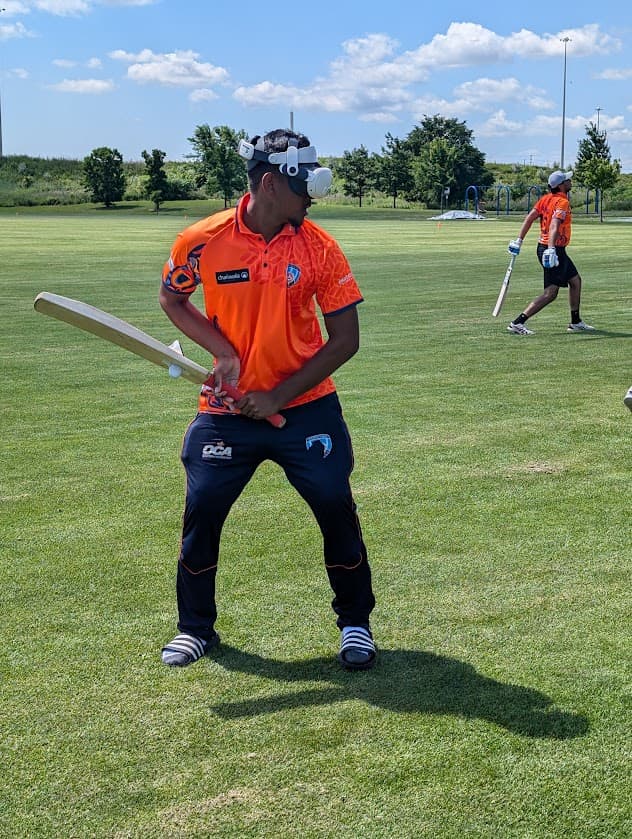
What does "realistic" mean for cricket batting?
Realistic VR cricket means the ball behaves and arrives as a real cricket ball does, the bat responds to your actual swing, and the visual environment closely matches a cricket ground. It does not mean identical — VR removes ground feel and slightly narrows peripheral vision. CricketX prioritises the elements that matter most for skill transfer over photorealism for its own sake.
"Realistic" is the wrong question if you treat it as a single yes or no. Batting is a stack of separate skills — reading the ball out of the hand, judging line and length, choosing a shot, timing it. VR reproduces some of those almost exactly and others not at all. The honest assessment below goes skill by skill rather than offering one blanket verdict.
How VR cricket simulates real batting on Meta Quest
VR cricket on Meta Quest uses headset cameras to track the bat's exact position and motion, while a physics engine simulates ball flight matched to real cricket telemetry. The bowler's run-up, release point, seam orientation, and pitch behaviour are all modelled from real match data. The player sees and responds as they would in a net.
If you are new to the format, our explainer on what VR cricket is covers the basics. In short: the Quest's inside-out cameras see the controller (held inside a CricketX smart bat handle) and reconstruct your swing in real time, so the bat in the headset moves exactly as the one in your hands does. Swing, seam, and spin are computed by a physics engine rather than scripted, which is why no two deliveries land identically.

What VR cricket gets right: the accuracies
VR cricket accurately reproduces six elements that matter most for batting skill — ball-tracking from release, line-and-length recognition, timing under pressure, decision-making in 0.5 seconds, shot-selection across the wagon wheel, and follow-through mechanics. Each of these is measurable and improves with practice, making them the parts of batting that VR training genuinely develops.
Ball physics and flight
CricketX uses physics-based ball simulation. Swing moves the ball in the expected arc depending on conditions and delivery type. Seam movement randomises within realistic bounds. Spin turns with the correct angle based on bowler type and release point. The ball does not behave in ways that would look wrong to a cricketer.
Pace and reaction time
At 80 mph, you have approximately 0.45 seconds from release to the crease. That is real. The time pressure you feel facing a quick bowler in VR is not reduced to make it easier — it matches the physics. If you can learn to pick up an 85 mph inswinger in VR, you are building a real skill.
Delivery variation and bowler types
CricketX generates pace bowlers (straight, swing, seam), spin bowlers (off-spin, leg-spin, wrong 'un), and mixed-length attacks. Each type requires a different mental approach. CricketX does not serve up a monotonous feed of identical deliveries — it forces real shot selection.
Shot data and feedback
Every delivery is recorded. After your session, the app shows where each ball landed, where you hit it, and your bat path through the shot. This is the kind of coaching data that professional setups pay significant money for. In CricketX, it comes from every single session.
What VR cricket does differently from a real pitch
Three elements differ honestly from a real pitch — the absence of ground texture underfoot, slightly narrower peripheral vision (around 110° in most headsets versus a natural 200°), and the missing physical impact of bat-on-ball contact. These differences become significantly less noticeable after the first two or three sessions as the brain adapts. They do not undermine the core batting skills VR effectively develops.
No ground feedback
In real batting, your feet sense the pitch surface and your body makes tiny adjustments — how firm is the ground, where to plant for a back foot shot, how the crease area feels underfoot. VR gives you none of this. Your feet are on your living room floor, and no software changes that.
Peripheral vision is reduced
Most Meta Quest headsets have a horizontal field of view of roughly 110°. Real human vision is closer to 200°. You see the ball, the bowler, and the pitch — but the wide periphery is compressed. Most players stop noticing this by their third session, but it is different from real batting.
No physical ball contact
When you hit a ball in VR, you feel nothing through the ball. The smart bat improves this by giving you the correct weight and feedback through your hands, but the contact sensation itself is absent.
Adrenaline and consequence
Facing a quick bowler in real cricket carries an element of physical risk and match consequence that VR cannot replicate. Some players report that their reactions in VR do not fully capture what they would do in a match situation because the stakes are different. This is a real limitation — but it is true of most nets practice too, not just VR.
The bat weight and balance point matter more than people expect — a bare controller feels nothing like a cricket bat. This is why CricketX's smart cricket bats hold the Quest controller inside a real bat handle, so the swing weight in VR matches the swing weight at the crease.

How long until VR cricket feels natural?
Most players need two to three sessions before VR cricket feels natural. The first session adjusts the brain to the headset and the tracking. By the second session, most are playing shots without thinking about the hardware. By the third, the experience is comparable to intense net practice for most adult cricketers. Children adapt even faster.
Every player goes through a calibration phase the first time they put on the headset. The brain needs a few sessions to accept that the virtual ball is real enough to play properly. Most players experience this as hitting slightly across the line, or playing defensive shots they would not play against the same delivery in real life. By session three, most players are batting naturally and the cricket takes over.
From Abdullah Rehan: My own experience was about three sessions. The first session felt slightly off — I was playing across the line on straight deliveries I should have driven. By session three the line felt right, and by week two I was trusting my VR sessions the same way I trust net sessions. The data confirmed what I felt: my shot accuracy in the app improved sharply between sessions one and four, then levelled off.
Does VR cricket transfer to real batting?
Yes, and the published evidence is stronger than most people assume. Gray (2017, Frontiers in Psychology 8:2183) ran a season-long study on batters using adaptive VR practice, real bowling-machine practice, and standard training. The adaptive VR group improved most on in-season performance, and the advantage was still visible five years later. The skills that transfer most reliably are the ones that matter at amateur and youth levels: ball tracking, timing, and shot selection.
The honest limits belong in the same breath. Pinder et al. (2011, Sports Medicine) declined to declare a winner between simulated and real practice. Witte et al. (2025) found negative transfer in a dart-throwing study, a reminder that immersion alone guarantees nothing. And no VR system reproduces ball impact on the bat.
Where transfer is clearest: players who have worked specifically on a technical weakness using VR — for example, playing around the ball from a particular angle — show improvement against that delivery type in real nets. Where transfer is less clear: the rhythm of a long innings, physical stamina, and footwork on a variable pitch. These still require real cricket or real net time. Treated as a supplement rather than a replacement, the transfer is real and meaningful.
Who has actually trained on it
CricketX has run filmed sessions at MCC Lord's in London, and professional players including Misbah-ul-Haq, the former Pakistan captain and head coach, and first-class cricketer Umaid Asif have batted in it on camera. Those sessions are published in full on the CricketX proof page, so you can judge them yourself rather than take a claim on trust.
What that does and does not mean is worth stating plainly. Filmed sessions show that serious cricketers were willing to bat in it and what they said afterwards. They are not a controlled study, and CricketX has not commissioned one. The academic evidence above validates the category and the hardware architecture, not this specific app. You can see the full feature set on the CricketX VR cricket simulator page, including the analytics and delivery types those sessions used.
VR cricket vs bowling machines: which is more realistic training?
Both have legitimate places in serious training. Bowling machines deliver consistent line-and-length physically, but they lack the visual cues a real bowler provides. VR cricket reproduces full visual context including bowler delivery, but lacks the physical ball. For pure technique repetition, bowling machines win. For decision-making, shot selection, and reaction to seam or spin variations, VR cricket wins. Most academies use both.
| Training factor | VR Cricket (CricketX) | Bowling Machine |
|---|---|---|
| Cost (UK) | App $20 + smart bat from $80 | £4,000 – £20,000+ |
| Indoor space required | 2m × 2m | 18-22m (full lane) |
| Visual realism | Full bowler animation, stadium, field | None — ball appears mid-flight |
| Variability of bowling | Pace, spin, swing, seam — full range | Limited to settings |
| Reaction-time training | Excellent | Excellent |
| Decision-making training | Excellent | Limited |
| Shot-selection training | Excellent (full wagon wheel) | None (machine doesn't react) |
| Physical ball contact | None | Real |
| Footwork training | Limited | Excellent |
| Setup time | 2 minutes | 15-30 minutes |
| Suitable at home | Yes | No |
| Data analytics | Built-in | Add-on (typically costly) |
VR cricket vs bowling machines — complementary tools, not substitutes.
The cost gap is the headline difference: a bowling machine runs into thousands, while getting started with CricketX is an order of magnitude cheaper. For a full breakdown of how much VR cricket costs, including the app, smart bats, and the Pro subscription, see our dedicated cost guide.
Frequently asked questions
Is VR cricket realistic enough to improve real batting?
Yes, for the cognitive skills that determine batting average — ball-tracking, line-and-length recognition, decision-making, and shot-selection. Gray (2017, Frontiers in Psychology) found adaptive VR batting practice outproduced both real machine practice and standard training on in-season performance. Physical footwork and pitch feel still require real net time. VR cricket is best treated as a supplement to net practice, not a replacement.
How long does VR cricket take to feel natural?
Most players need two to three sessions. The first session is about adjusting to the headset. By session three, most are playing shots without thinking about the hardware. Children typically adapt faster than adults. After the adjustment period, the experience is comparable to intense net practice for the cognitive elements of batting.
What's the biggest difference between VR cricket and real batting?
Three honest differences — no ground texture underfoot, slightly narrower peripheral vision (about 110° versus natural 200°), and no physical bat-on-ball impact. These differences become significantly less noticeable with practice. They do not undermine the core batting skills VR effectively develops, particularly ball tracking and decision-making.
Do professional cricket academies actually use VR cricket?
Yes. CricketX has run filmed sessions at MCC Lord's in London, and professional players including Misbah-ul-Haq and Umaid Asif have trained with it on camera. Academies use it as a supplement to physical training rather than a replacement. You can watch those sessions on our proof page.
Can VR cricket replace net practice?
No, and it is not designed to. VR cricket excels at the cognitive elements of batting — tracking, decision-making, and shot selection. Physical net practice provides ground feel, real ball contact, and movement variation that VR cannot reproduce. The best training results come from combining both approaches across a weekly schedule.
How realistic is CricketX compared to other VR cricket apps?
CricketX is the only VR cricket simulator built specifically for training, with real-physics ball modelling, swing-path analytics, and smart cricket bat hardware that mimics real bat weight and balance. Other VR cricket apps like iB Cricket are entertainment-first and use standard Quest controllers, which weakens the technique transfer to real batting significantly.
See our best VR cricket apps compared for the full picture.
Is VR cricket realistic enough for U19 talents to use?
Yes, and it is increasingly common in age-group programmes. Runswick et al. (2026, European Journal of Sport Science) tested a Meta Quest cricket simulator using the same architecture — a real bat with the controller attached — and found it reliably separated county pathway, club and novice players. The cognitive skills VR develops are particularly valuable at the age when these foundations are being established.
Related guides
What Is VR Cricket?
New to VR cricket? Start here for the full explanation.
VR Cricket Beginner's Guide
Hardware, setup, first session — everything new players need.
VR Cricket Setup Guide
Room setup, Guardian, and bat calibration step by step.
CricketX VR Overview
Full feature breakdown — analytics, delivery types, Pro mode.
The honest verdict
VR cricket is realistic enough to develop the cognitive skills that matter most for batting — tracking, decision-making, shot selection, and reaction time. It is not a replacement for net practice; it is a supplement that lets you train when nets are unavailable, face varied bowling at home, and capture analytics no physical session can. The published research supports the category; the filmed sessions at Lord’s show what it looks like in practice. Judge both on their merits.
Want to try CricketX for yourself? The app is available on the Meta Quest Store for $20. Smart cricket bats start at $80. CricketX Pro unlocks Analysis Mode, Special Deliveries, and Legendary Match recreations.